
May 27, 2007
Care of Red Eared Sliders
When you think of Red Eared Sliders, do you think of the tiny quarter or half dollar sized turtles that used to be sold in petstores (and in some places still are)? If so, youre not alone. That image is the one that comes to mind when many people think of these turtles. However, those tiny little turtles (most of whom died shortly after their purchase) are only one of many red eared sliders of which can be long lived, healthy, hearty, rewarding pets.
Turtles are in the reptile family, which means they are ectothermic, or cold-blooded. Cold-blooded animals rely on external heat sources, such as warm ground, basking lights, sunshine, and other methods to warm their bodies. Red eared sliders are the origanal sun worshippers and can often be found sleeping on rocks or logs, soaking up the rays.
Red eared sliders, such as all turtles have shells. Their shell is like a box-like exoskeleton (external skeleton) with the spine and ribs fused to the top of the shell. These bones are in fact part of the carapace or top shell. The shell itself is made out of bone, and the outer covering of the shell is made of keratin, much like human fingernails.
Each shell is made up of sections called scutes. As the red eared slider grows, new layers of keratin are formed around the outer edges of each scute, looking much like the growth rings of a tree. The picture below explains each part of the redeared sliders shell and scute areas.
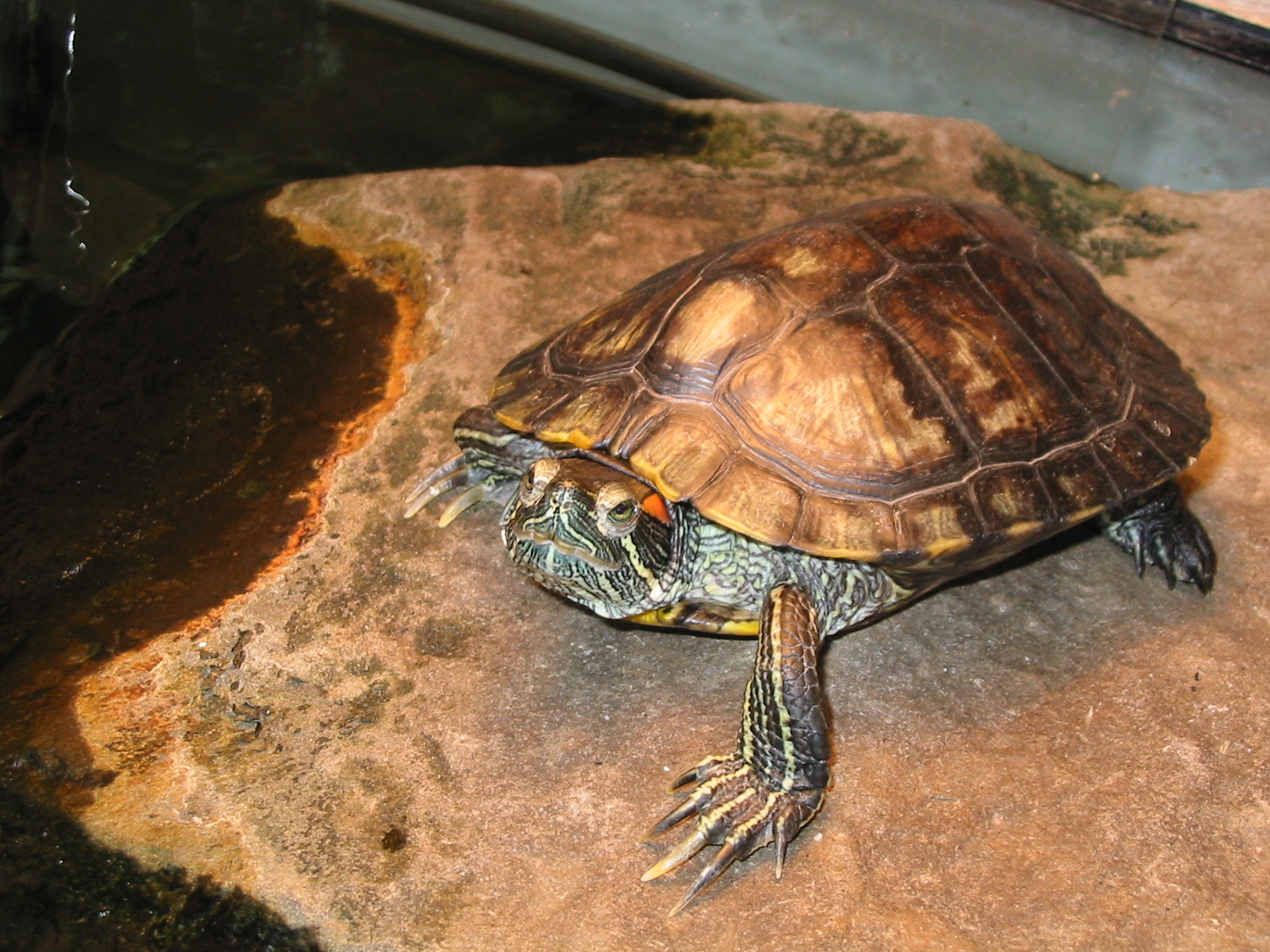
Red eared sliders can pull in all four legs and their head so that the shell protects them from preditors. Red eared sliders also have hard, rough skin on their legs for further protection. The skin on the legs (front) have little scales made of keratin which add a little more armour to this hardy turtle.
What does a Red Eared Slider require from you?
[snip left2][/snip]Alot of people by their first turtle or tortoise accidently. Perhaps you wandered into a pet-store to buy some fish but instead this little cute turtle catches your eye. You buy the turtle, bring it home, and throw it in with your guppies. One week later it’s swimming funny and not eating. You log onto the net and see what your doing wrong. Fortunently you find a good care sheet and put it to work. This is what you find:
The Red Eared Slider (Trechymys scripta elagans) can live up to 30 to 50 years. The red-eared slider is found throughout the United States. In the early and late 70’s the red-eared slider was one of the most popular pets in all of North America. This posed a problem though. Most turtles back then were sold at pet stores as hatchlings. You could also purchase a little plastic island bowl where it lives in. Since all people were not informed or knew how to care for red-eared sliders, a small minority developed salmonella poisoning. When the gov’t cracked down on this outbreak, their keepers in fear of catching salmonella destroyed millions of turtles. The American government made a law that all turtles must be over 4” to sell at pet stores. They made this rule because young kids usually stuck these turtles in their mouths and kept them in dirty conditions. The Canadian government banned all turtles from pet stores and made them illegal to sell but you are aloud to keep them.
Making a proper habitat
From personal experience, if you make them a clean, nice habitat they will live longer and be and will also have little medical problems. If you have a hatchling, I would recommend a 15 to 30 gallon tank. For an adult 50 gallon and up. The bigger the tank, the better. Turtles love to swim and bask, and with the proper size of tank, you as the keeper can make it very unique and comfy. The main components of a turtle aquarium are basking areas , water , lighting , filtration and heat .
Many elemants come together to create a home for a red eared slider. Because water quality is important, choose a filter to keep the water clean, and add some aquatic plants. You will also need a fully submersable water heater with a water temperature around 76′ to 82′. Your red eared slider is a very good escape artist. Keep this in mind while creating a basking area. Make sure he/she cannot climb out of the aquarium. When constructing a basking area, think simple. Although tri-level basking areas, & assorted stones look attractiv, they can be very difficult to clean. Below is an example of a good basking area.
When I constructed this area, I used 3 PVC pipes, which a siliconed to the bottom of the aquarium. On top I used some slate rock, and some sandblasted wood. Using the pvc pipe, I saved around 20 gallons of swimming room for my red eared sliders.
Filtration
Filtration is the most important thing you can get if you have a turtle. Don’t be cheap. The bigger the filter the less you have to clean and the less smell from your tank. From my personal experience, I would recommend the External canister Fluval 404 for 50-gallon aquariums and up. For smaller aquariums I use the fluval 203 external. The benefits of an external canister filter are plenty. First and foremost it creates more room for your turtle. The filter canister itself produces more volume of clean water, which goes through a very well made filtration system. It is also a good idea to have some good circulation in the water, such as a bubbler or something. This will keep the water moving and prevent the smell of “still” water.
Heaters
I’d recommend a fully submersible heater. I use a Tronic heater. Works great! There is a lot of conflict on what the temperature in a turtle tank should be. I have mine on 75’ to 78’. They seem to enjoy this temperature and they are also more active. I know other keepers who have their temps on 70’ to 73’. From word of mouth they seem to be fine to. I guess it depends on your preference. Below are some popular heaters that some keepers use.
Basking Light
There has been a lot of debate of this too. Personally this is what I do. Over the basking area I have a 150-watt UVA basking light. Full spectrum & UVA gives chelonians the proper lighting, and the 150-watt heat keeps them very warm when they bask. UVB light is also a must. Turtles need this lighting for vitamin D3 purposes and also for proper shell growth. You can buy UVB lighting in Flourescent tubes. ZooMed makes the most powerfull at this time.
Feeding
I feed my sliders reptimen & nutrafin turtle pellets. Also apples, romaine lettuce and beef heart. My turtles eat every second day in a seperate container. They basically have an “all you can eat buffet” until they are full. Using the proper diet will assure proper growth. You will also not run into problems such as Metabolic bone disease.
[snip center][/snip]